Hollis Prism 2 Rebreather
Get-N-Wet Scuba is an authorized Hollis Prism 2 dealer, and we're also a full service and repair facility for the unit, right here near Harrisburg, PA. Whether you're shopping for your first rebreather, ready to make the jump from open-circuit to closed-circuit diving, or you already own a Prism 2 and it's time for your bi-annual service, our team can help.
Sales, Service & Bi-Annual Maintenance at Get-N-Wet Scuba
As a Hollis Prism 2 dealer, service, and repair facility, Get-N-Wet Scuba can help you purchase a new unit or keep the one you already own running the way it should. Rebreathers need more disciplined upkeep than standard open-circuit gear, and Hollis recommends bi-annual servicing to keep your Prism 2 performing safely and reliably. Our team can schedule that service for you and handle repairs if something needs attention between visits.
 What Is a Rebreather, and Why Choose the Prism 2?
A rebreather doesn't just dump the air you exhale into the water like a normal scuba regulator does. Instead, it recycles your breathing gas, scrubbing out the carbon dioxide and adding back just enough oxygen to keep the mix breathable. The payoff is longer dive times, no bubbles to scare off marine life, and a much smaller gas footprint for a given dive. It's a serious step up in both capability and complexity, which is exactly why buying, learning, and servicing one should happen through a dealer who actually knows the unit inside and out.
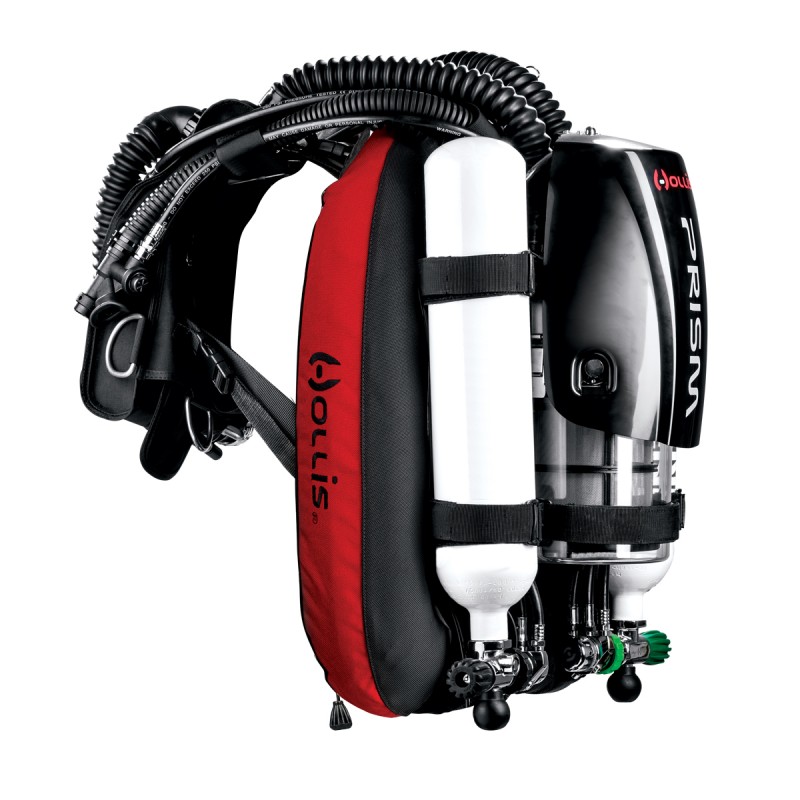
The Prism 2 is built by Hollis, a name well known in the technical diving world, and it's designed around redundancy and diver control. Below is a plain-language walkthrough of how the unit is put together.
How the Breathing Loop Works
At the center of any rebreather is the breathing loop, the closed path your air travels as you breathe in and out. On the Prism 2, that loop starts at a keyed, one-way mouthpiece assembly. Mushroom check valves sit on either side of the mouthpiece, and their only job is to make sure your breath flows in one direction around the loop instead of doubling back on itself.
Scrubber Design
Every rebreather needs a way to remove the carbon dioxide you exhale before that air gets recycled back to you. On the Prism 2, that's handled by a radial flow scrubber canister, mounted vertically on a backplate attached to the integrated BC. It sits right between the unit's twin supply cylinders, one holding oxygen and the other holding diluent gas.
Counterlungs
The Prism 2 uses dual, front-mounted counterlungs, which act as a flexible reservoir for your breathing gas. They're sized to match the maximum volume of your own lungs, which keeps the physical effort of breathing as low as possible at any depth. Each counterlung includes both automatic and manual gas addition systems, plus a variable volume control valve you can use on ascent to vent excess expanding gas or purge the loop entirely. As you descend and hydrostatic pressure increases, the counterlung naturally collapses against a valve actuator, which automatically adds diluent gas without you having to think about it.
Electronics and Displays
The Prism 2's electronics, sensors, and batteries live in the electronics head assembly at the top of the scrubber, with hoses running over your shoulders into the top of each counterlung. You get two displays: an analog LED primary display for a quick, at-a-glance read on unit performance, status, and alarms, and an independent digital OLED secondary display that verifies everything the primary display is telling you.
With the electronics powered on, the secondary display also shows your battery status, your selected set point for the dive, and other critical dive information. Behind the scenes, the electronics constantly "vote" between three separate proprietary galvanic oxygen sensors and use that consensus to control a low-wattage solenoid valve on the oxygen supply, keeping your gas mix where it needs to be.
Built and Tested for Reliability
Hollis backs the Prism 2 with a quality assurance process that matters when your life depends on the gear working correctly every single dive:
- 100% in-house assembly. Every Prism 2 is hand-assembled and tested in Salt Lake City, Utah, including a pressure test to 300 feet before it ever ships.
- Module C2 Certificate from SGS. Hollis Rebreathers' systems and processes are independently audited every year to confirm they meet regulatory requirements, so build quality stays consistent unit to unit.
- Certified critical components. The critical oxygen components are certified to ASTM G93 Level B and meet the requirements of MIL-STD-1330.
CE Certification
The Prism 2 is CE approved for sale and training throughout the UK and EU. Both the front-mounted and back-mounted counterlung variants exceed all test requirements and comply with the EN 14143:2013 standard, the European benchmark for rebreather safety and performance.

FAQ
What makes a rebreather different from regular scuba gear?
A rebreather recycles your exhaled breath instead of venting it into the water. It scrubs out carbon dioxide and adds back oxygen, which extends your dive time, eliminates bubbles, and uses far less gas than open-circuit scuba for the same dive.
Do I need special training to dive the Prism 2?
Yes. Rebreather diving requires dedicated certification beyond standard open-circuit training. Contact our team to talk through the training path for the Prism 2.
How often does the Prism 2 need servicing?
Hollis recommends bi-annual service. Get-N-Wet Scuba is an authorized service and repair facility and can schedule that maintenance for you.
Is the Prism 2 certified for use outside the US?
Yes, it's CE approved for sale and training in the UK and EU, and both counterlung variants meet the EN 14143:2013 standard.
Can Get-N-Wet Scuba repair a Prism 2 I already own?
Yes, we're a Hollis Prism 2 dealer, service, and repair facility. Contact our team to schedule service or discuss a repair.